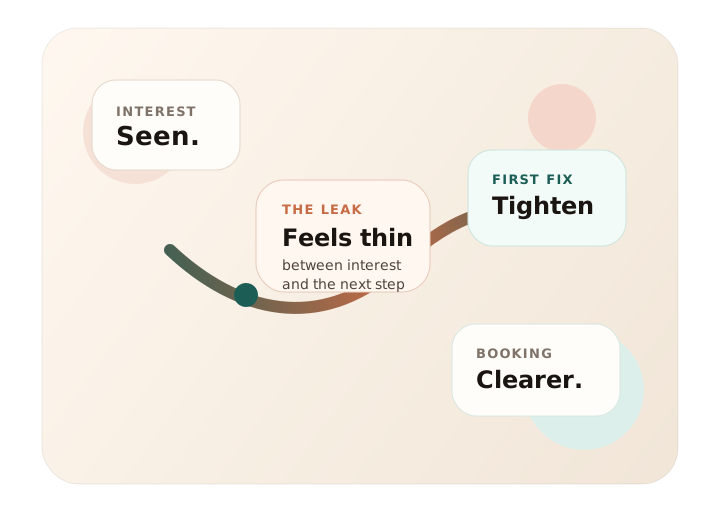
We review public signals before the form, then ask only for the basics we still need.
Find the leak. Fix the leak. Prove what came back.
ClientFlow is built for med spas that already have demand, but are quietly losing revenue through follow-up gaps, friction, weak next steps, and fuzzy proof. The experience is designed to feel short, clear, and low-pressure from the first form onward.
No long intake. No forced call. No noisy dashboard pretending to be progress.
Calmer, tighter, more believable.
- Short intake instead of a giant discovery form.
- Clear next-step language instead of funnel theatrics.
- Optional booking instead of a cold scheduler trap.
- Useful pilot framing instead of vague “marketing support.”
- Simple proof path instead of fuzzy attribution stories.
- One operator view that answers what needs attention now.
Three simple stages, each designed to lower friction.
The public experience should not feel like a software demo or an interrogation. It should feel like a confident service business that knows what it needs, knows what can wait, and respects the person on the other side.
The person can book immediately, continue by email, or step away without losing their place.
The internal dashboard is built around decisions, follow-up, proof, and QA instead of decorative noise.
Med spas only, for now.
The point is not to look broad. The point is to build one proven acquisition-and-recovery template for med spas, use it repeatedly, collect proof, and only expand after the pattern is real.
We infer the public basics so we can ask fewer questions live.
We fix the highest-value leak and protect the proof path from day one.
We only claim what the evidence can support.
The actual offer.
Step 1: audit the spa. Step 2: fix what is blocking revenue. Step 3: spend the first month bringing in customers and proving which ones came from ClientFlow.
- Response-speed leaks that cost booked patients.
- Review-response gaps that quietly erode trust.
- Messy booking paths that drop warm demand.
- Weak reporting that makes good work hard to defend.
The interaction rules are part of the product.
We are not treating the website, booking page, and dashboard as wrappers around the work. They are part of the trust layer. If the first experience feels bloated or annoying, the business already feels less believable.
Single-column forms
One clear question at a time beats scanning across two competing columns.
Optional means optional
Extra context is hidden until the person chooses to give it.
Clear next step
Every page explains what happens next and what does not need to happen yet.
Action-first dashboard
The first thing an operator sees is what needs approval, follow-up, or QA.